what vector image function helps you to draw lines and curves and create geometric shapes?
What are vector graphics?
Vector graphics are calculator images created using a sequence of commands or mathematical statements that place lines and shapes in a 2-dimensional or 3-dimensional space.
In vector graphics, a graphic artist's piece of work, or file, is created and saved every bit a sequence of vector statements. A vector graphic file describes a series of points to exist connected.
These files are sometimes chosen geometric files. Images created with tools such as Adobe Illustrator and Corel'south CorelDRAW are normally vector image files.
Simplified, vector graphics are similar connect-the-dots drawings.
What are vector graphics used for?
Graphic artists, illustrators and designers use vector graphics for a variety of reasons, including the following:
- Scalability. Vector formats are skillful for projects that require scalable graphics, including scalable type and text. For example, visitor and brand logos are displayed at unlike sizes; they testify upward in the corner of a mobile application or on a roadside billboard. A logo created with vector graphics can be scaled up or down without loss of quality or creating a large file.
Information technology was the scalability feature of vector graphics that resulted in its return, later on falling out of favor to raster graphics in the 1980s. Vector graphics were originally used in computer displays in the 1960s and 1970s. Earth Broad Web Consortium worked on Vector Markup Language, which evolved into the Scalable Vector Graphics open source language that contains vector and raster elements.
- App and web development . Vector graphics are useful in application and web development considering web apps and the graphics they contain must work with various screen sizes and device types. For instance, Amazon WorkLink is a mobile app that enables a fully interactive representation of corporate information on an employee's mobile device.
- Animation. Animated images are likewise unremarkably created as vector files, which provide for cleaner and smoother images.
- Figurer-aided design (CAD). CAD programs frequently use vector files for manufacturing, engineering and design because of their scalability and ease when it comes to editing the mathematical formulas.
Vector vs. raster
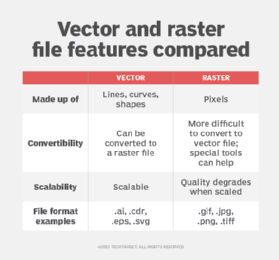
A raster graphics paradigm maps bits directly to a display infinite, too called a bitmap. Raster graphics are made upwards of a stock-still number of pixels, which makes them less scalable than vector graphics. At a certain bespeak, when the raster image is enlarged enough, the edges get ragged, and it appears pixelated -- i.e., when the pixels become visible. Raster graphics cannot exist scaled up without sacrificing paradigm quality.
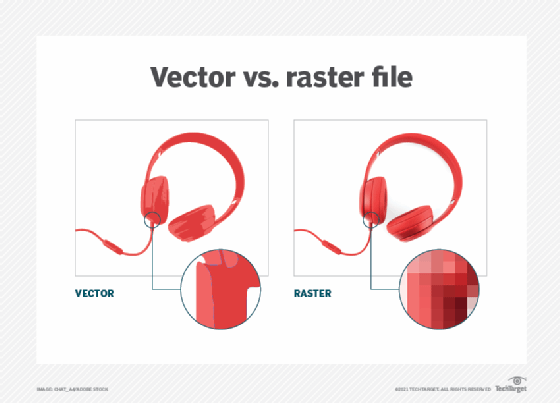
At that place is also a one-to-one relationship between each pixel and the memory raster graphics occupies on a computer. Computers must store information for every pixel of a raster image, whereas vector images only store the series of points that demand to exist connected by lines, curves, etc. Consequently, vector files are usually smaller than raster files. Vector image files are easier to change than raster image files for this reason.
Vector and raster images can be converted into one another with the right software. Adobe Illustrator and Adobe Photoshop are examples of software that enable users to convert one image format to the other.
Raster files are particularly skillful for portraying colour depth, every bit each pixel can be a different color. And at that place are more pixels that tin be unique colors than vectors that tin be unique colors. This makes raster file formats good for editing digital photographs.
Certain file types can include vector and raster elements -- PDF and SVG files are ii examples.
Advantages and disadvantages of vector graphics
It is important to consider both the benefits and drawbacks of using vector files.
Advantages
- Scalability. As previously mentioned, this is the principal advantage of vector graphics. Because vector graphics are derived from mathematical vector relationships, or relationships between points that create lines and curves, they appear clean and verbal at whatsoever size.
- Small file size. Vector graphics generally have a pocket-size file size because they only shop a pocket-size number of points and the mathematical relationships between them. Those relationships are expressed in code, which is less retentivity-intensive compared to storing pixels.
- Easy to edit. Vector files are piece of cake to edit considering users can change vector relationships fast to swap out colors or change line shapes, for example. This is useful in an iterative process, like graphic design, that requires a lot of editing.
- Like shooting fish in a barrel to load. Because file sizes are smaller, it is easy to port and load vector files to unlike devices and programs.
- Easy to duplicate. It is also easy to create clones of a vector image and copy certain features of i graphic to some other.
- Precision. The ability to scale vector graphics up or downwardly means they have a precise await and experience.
Disadvantages
- Less detail. Vector files are limited in dealing with complex images. For example, photographs require color shading and blending that vector files cannot provide equally well as raster files.
- Skill and fourth dimension requirements. Vector files can require more skill and time to create.
- Express browser support. There is less support for vector graphics on web browsers than for raster graphics.
- Inconsistency. Vector images tin vary from ane awarding to another, depending on how compatible the rendering and creating applications are, among other factors.
Types of vector files
There are several usually used vector file types. They include the following:
- .ai -- Adobe Illustrator File
- .cdr -- CorelDRAW Image File
- .dxf -- Drawing Exchange Format File
- .eps -- Encapsulated PostScript File
- .svg -- Scalable Vector Graphics File
- .wmf -- Windows Metafile
Different file types are used for dissimilar tasks. For example, AI files are commonly used in print media and digital graphics. EPS files can be both raster and vector files. They typically comprise a smaller blueprint element that can exist embedded in a larger design. This makes them suitable for sending logos, which are frequently incorporated into larger designs.
This was last updated in June 2021
Continue Reading Near vector graphics
- App interface blueprint principles all developers should know
- 10 tips for implementing visualization for big data projects
- How to handle increasing VDI graphics processing needs
Source: https://www.techtarget.com/whatis/definition/vector-graphics

Postar um comentário for "what vector image function helps you to draw lines and curves and create geometric shapes?"